The Cost-of-Living Crisis Is Becoming a Job-Market Crisis
How inflation and high interest rates are squeezing Australia's job market, accelerating cost-cutting, layoffs and the shift towards offshore labour.
By Stefan C.
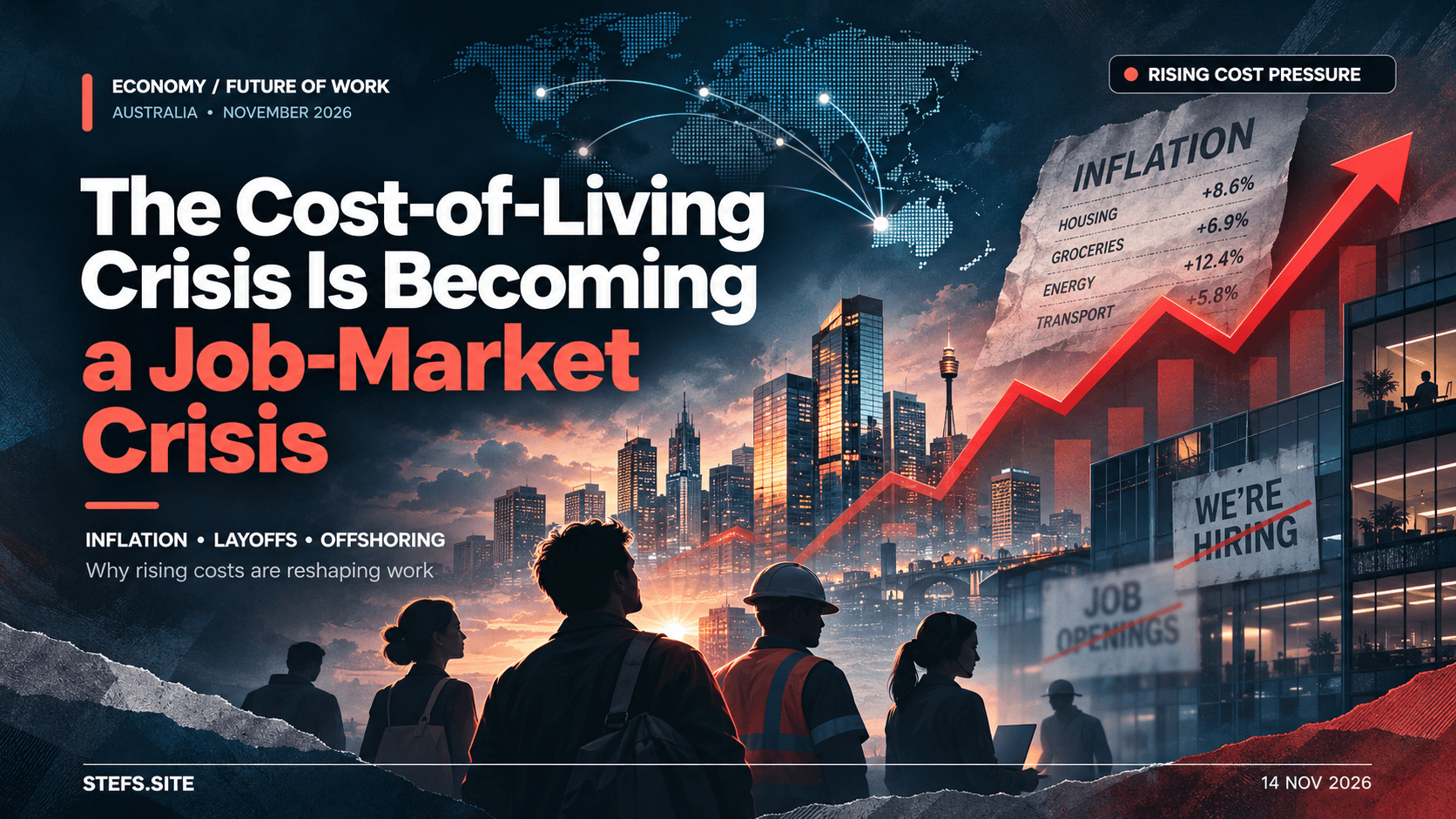
Why rising inflation, higher interest rates, offshoring and AI are creating a perfect storm for Australian workers.
Everyone is talking about the cost of living. Groceries cost more. Housing costs more. Insurance, electricity, transport and almost every essential expense seem to be heading in one direction.
But there's another consequence of inflation that receives far less attention: what happens to the job market when everything becomes more expensive?
We are experiencing an economic contradiction. Workers need higher salaries simply to maintain their standard of living, while employers face rising operating expenses, tighter budgets and more expensive borrowing.
Meanwhile, businesses are increasingly turning towards offshore labour, automation and artificial intelligence to reduce costs.
The result isn't necessarily an immediate wave of unemployment. It's often something less visible: fewer vacancies, frozen recruitment, contracts that aren't renewed, longer hiring processes and growing competition for the positions that remain.
And for those already looking for work, the consequences are becoming increasingly difficult to ignore.
1. When Inflation Rises, Hiring Often Becomes the First Casualty
Inflation doesn't automatically cause unemployment. During periods of strong economic growth, rising prices can coexist with strong hiring.
The problem arises when inflation remains elevated while businesses and households lose purchasing power.
Consider the pressures facing an Australian business:
- Operating expenses increase: Rent, insurance, energy, software subscriptions and supplier costs become more expensive.
- Financing becomes harder: Higher interest rates make business loans and expansion projects more costly.
- Consumer spending weakens: Households reduce discretionary purchases to cover essential expenses.
- Wage expectations rise: Employees need pay increases to keep pace with inflation.
- Investment decisions become riskier: Businesses hesitate to launch projects without confidence in future demand.
Employers generally have several ways to respond: increase prices, accept lower margins, improve productivity or reduce expenditure.
Unfortunately, reducing expenditure can mean reducing the workforce.
However, companies don't always begin with mass redundancies. They may initially freeze vacancies, delay promotions, postpone recruitment or decide not to replace departing employees.
A business that previously hired ten people might recruit only five. No redundancy announcement is necessary, yet five potential opportunities have disappeared.
This is how a weakening labour market can emerge well before unemployment statistics reveal its full impact.
2. Higher Interest Rates Can Make the Employment Squeeze Worse
Central banks typically respond to persistent inflation by increasing interest rates to slow spending and bring inflation back towards target.
In Australia, the Reserve Bank raised its cash rate to 4.85% on 3 November 2026, following a series of increases throughout the year.
The RBA is attempting to contain inflation, which reached 4.3% annually in September 2026, above its 2–3% target.
Sources: Reserve Bank of Australia and Australian Bureau of Statistics.
Here's the uncomfortable reality: monetary tightening works partly by reducing spending and slowing economic activity.
When customers spend less, businesses often need fewer additional workers.
For highly leveraged businesses and startups, the effect can be particularly severe. More expensive capital makes expansion less attractive and increases pressure to generate immediate profitability.
Projects that seemed financially viable when money was cheap may no longer survive a higher interest-rate environment.
This creates a chain reaction:
Persistent inflation → Higher interest rates → Reduced household spending and business investment → Lower labour demand → Hiring freezes and potential layoffs.
Not every company experiences this sequence, and the effects can take months or years to emerge.
But when businesses across an economy simultaneously become more cautious, the cumulative impact on recruitment can be substantial.
The RBA itself expects unemployment to rise further, even though total employment is forecast to continue growing.
In other words, the economy can still create jobs while becoming significantly harder for individuals to find one.
3. Australia's Job Vacancies Tell a Revealing Story
The numbers suggest that the post-pandemic hiring boom has given way to a much more competitive labour market.
According to the ABS:
- Australia had approximately 472,700 job vacancies in May 2022, the peak of the series.
- By August 2026, that figure had fallen to 325,000.
- That's a 31.2% reduction in available vacancies compared with the peak.
- Private-sector vacancies fell another 2.0% between May and August 2026.
Source: ABS — Job Vacancies, August 2026.
The situation becomes more concerning when competition is considered.
SEEK's September 2026 Employment Report showed job advertisements were 3.5% lower than a year earlier, despite a small monthly recovery. Applications per advertisement continued rising and reached a new peak in its reported series.
Source: SEEK Employment Report — September 2026.
This explains why unemployment figures alone can provide an incomplete picture.
Australia's seasonally adjusted unemployment rate reached 4.7% in September 2026, but that number doesn't reveal how many employed people are searching for better work, how many contractors are struggling to secure their next engagement, or how much competition exists for individual vacancies.
To be clear, employment has not collapsed. Some industries continue to expand, and Australia's total employment remained higher than a year earlier.
But the shift away from the extraordinarily tight labour market of 2022 is real.
For jobseekers, fewer opportunities combined with greater competition can make finding suitable employment considerably harder.
4. Offshoring: When Cutting Costs Means Moving Jobs Overseas
One of the most significant consequences of growing corporate cost pressure is the incentive to move work to lower-cost labour markets.
For decades, Australian businesses have outsourced functions such as customer support, software development, IT operations, administration and accounting.
Technology has made these arrangements easier than ever.
Cloud infrastructure, collaboration platforms, remote access technologies and globally distributed teams allow companies to employ people almost anywhere.
From an employer's perspective, the economics can be compelling.
Why pay a higher local employment cost when certain functions can be delivered from another country for less?
That calculation involves more than wages: businesses must also consider productivity, training, security, compliance, communication and service quality.
Nevertheless, the financial incentives are substantial enough that offshoring remains an attractive restructuring strategy.
Qantas and the reality of Australian job offshoring
On 10 November 2026, Qantas announced plans to cut 850 Australian jobs over the coming years, while transferring some corporate functions to Accenture.
Some of that work will be performed by teams based primarily in India.
The affected areas include finance, procurement, human resources and marketing.
Qantas presented the partnership as part of a wider technology and AI transformation. Unions, however, questioned whether AI was being used to justify conventional outsourcing and cost reductions.
Sources: Reuters — Qantas job cuts and offshoring and Reuters — Australian companies face AI-washing allegations.
Qantas is not alone. Reuters also reported on workforce restructuring involving other major Australian businesses, including Telstra, WiseTech and Atlassian, although the motivations and extent of offshoring differ between companies.
This raises an important question:
If a company transfers work to employees overseas before automating it, is technology eliminating the job, or is the employer relocating the job to reduce costs?
The distinction matters.
Offshoring is not a new consequence of inflation, nor is every outsourcing arrangement a direct result of interest-rate increases. International wage differences, skills availability, globalisation and corporate strategy have driven these decisions for decades.
However, persistent cost pressure can strengthen the incentive to accelerate them.
And every position relocated offshore potentially represents one fewer opportunity for the domestic labour market, even if the work itself still exists.
5. Contractors and Temporary Employees Can Feel the Impact First
When an organisation faces financial uncertainty, permanent employees are not necessarily the first to lose their positions.
Often, the initial adjustments happen elsewhere.
Contractors may finish an engagement without an extension. Temporary positions may expire without replacement. Consultants may lose project funding. Recruitment agencies may see clients defer hiring decisions.
These changes can happen without a company announcing a major redundancy programme.
Consider a technology business facing a reduction in its operating budget.
Management might decide to cancel a cloud migration project, postpone a new application launch or reduce spending on external engineering services.
The consequences ripple through the workforce.
A DevOps contractor loses a potential extension. A software engineer never receives an expected offer. A technical support position remains vacant after someone resigns.
The business can report relatively stable permanent headcount while opportunities across its broader employment ecosystem decline.
The OECD's 2026 Employment Outlook highlights the vulnerability of younger labour-market entrants and people on fixed-term contracts when economic conditions deteriorate.
Source: OECD Employment Outlook 2026.
This makes the decline particularly consequential for graduates, career changers and professionals who rely on contracting.
6. AI Is Adding Another Layer to an Already Difficult Job Market
Artificial intelligence is often promoted as the solution to rising business costs.
Automate repetitive tasks. Reduce administrative workloads. Improve developer productivity. Handle routine customer enquiries.
In principle, these improvements can allow businesses to expand output and create new opportunities.
But there is an alternative outcome: companies use productivity gains to maintain or increase output with fewer employees.
For technology workers, this raises an increasingly difficult question.
If AI enables a smaller engineering or support team to handle the same workload, will employers reinvest those savings into expansion, or simply reduce recruitment?
Is AI actually responsible for the layoffs?
The evidence is more complicated than many corporate announcements suggest.
In its August 2026 Job Vacancies Survey, the ABS reported that:
- 81.8% of responding businesses said AI had not affected their vacancy levels.
- 3.8% said AI had reduced vacancies.
- 0.6% said AI had increased vacancies.
The survey excluded businesses with fewer than five employees and did not measure job losses among existing workers.
Source: ABS — AI Impact on Job Vacancies.
These findings suggest that AI has not yet caused a universal collapse in recruitment.
Nevertheless, certain industries are more exposed. Information media and telecommunications recorded a considerably higher proportion of businesses reporting AI-related reductions in vacancies.
And the future could look different as the technology matures.
The more immediate issue is that AI, offshoring and conventional cost-cutting can become intertwined within the same corporate restructuring programme.
Without transparency, it becomes difficult to establish whether positions were genuinely automated, transferred offshore or removed because management wanted a smaller wage bill.
7. The Workers' Double Squeeze
The most concerning part of this economic cycle is how it affects workers from both directions.
First, inflation reduces the purchasing power of their income.
Then, higher interest rates and weaker business conditions can make employment less secure.
Workers may be forced to accept smaller salary increases, less favourable contracts or roles below their level of experience.
At the same time, employees who lose their jobs face a hiring market where more candidates are competing for fewer positions.
This creates a significant imbalance.
Businesses can respond to rising costs by increasing prices, restructuring, outsourcing or automating.
Workers have far fewer immediate options. They cannot relocate their mortgages overseas, automate their rent or easily reduce the price of essential groceries.
Those who are unemployed face an especially difficult situation: living expenses continue rising even when employment income disappears.
The OECD reported that real wages in Australia remained more than 2% below their early-2021 level in the first quarter of 2026.
That is a reminder that a nominal pay rise doesn't necessarily translate into improved living standards.
Even when inflation falls, prices generally don't return to their previous levels. They simply increase more slowly.
For workers, the damage to purchasing power can persist long after the inflation rate has peaked.
8. Does This Create a Self-Reinforcing Economic Problem?
There is a potential negative feedback loop worth considering.
Businesses reduce local recruitment and employment to protect profitability.
Affected workers then reduce discretionary spending.
Lower household consumption weakens revenue for businesses dependent on domestic customers.
Those businesses, in turn, may become more cautious about hiring.
If the cycle becomes widespread, it risks producing weaker demand and further labour-market deterioration.
This doesn't mean every instance of offshoring reduces total economic activity. International trade and productivity improvements can lower costs and enable other businesses to expand.
But it raises a question about how the benefits are distributed.
What happens when businesses become more productive and internationally competitive, but local workers receive a diminishing share of the resulting opportunities?
If productivity gains are primarily captured through reduced employment costs rather than higher wages, new investment or domestic job creation, the benefits may be uneven.
And if a growing number of households experience insecure employment at the same time, the domestic economy may face an additional demand problem.
9. What Needs to Change?
Controlling inflation remains important. Persistent price increases undermine purchasing power, savings and economic confidence.
However, inflation should not be the only indicator of economic success.
Policymakers and business leaders also need to consider the quality, availability and security of employment.
That means paying closer attention to:
- Job vacancy trends and candidate competition, rather than relying solely on headline unemployment.
- Contractor and temporary workforce outcomes, including non-renewals that may not appear in redundancy announcements.
- Transparency around offshoring and AI, so employers can distinguish actual automation from relocating work overseas.
- Domestic skills development, particularly opportunities for graduates and workers transitioning into new technologies.
- Investment in productivity that benefits workers, not only shareholders and company margins.
Businesses also face a strategic choice.
Reducing labour costs may deliver short-term financial improvements, but persistent underinvestment in staff development, local technical expertise and workforce resilience can create long-term risks.
For industries such as cloud infrastructure, cybersecurity, software development and IT operations, experienced teams remain essential to maintaining secure and reliable systems.
AI can assist these professionals, but technology still requires people to design, operate, troubleshoot and govern it.
The answer should not automatically be to replace every possible worker with the lowest-cost alternative.
10. The Bigger Question: What Kind of Job Market Are We Creating?
The post-pandemic employment boom demonstrated what happens when businesses compete aggressively for a limited supply of workers.
Employees had greater bargaining power. Companies offered higher salaries, flexible working arrangements and attractive conditions to secure talent.
Today's environment is increasingly different.
Job vacancies have declined substantially from their peak. Competition for advertised positions has intensified. Interest rates remain elevated. And technology makes it easier for employers to source labour internationally.
None of these changes independently proves that inflation is responsible for every hiring freeze, redundancy or offshore contract.
But together, they create an environment in which employers have stronger incentives to limit domestic labour costs while workers face weaker bargaining power.
The danger is that we begin treating reduced employment opportunities as an acceptable side effect of improving economic efficiency.
A company can become more profitable while reducing its Australian workforce.
An economy can continue growing while particular professions experience declining opportunities.
And inflation can eventually return to target without restoring the purchasing power or career prospects that workers have lost along the way.
The real measure of economic success should not simply be whether inflation falls or corporate profitability rises. It should also be whether people can find stable, reasonably paid work and afford a decent standard of living.
Because if everything becomes more expensive while secure employment becomes harder to obtain, the cost-of-living crisis risks becoming something much more enduring.
A crisis of opportunity.
This article presents economic commentary informed by publicly available research and reporting as at 14 November 2026. While inflation and interest-rate changes can influence employment decisions, layoffs and offshoring are also driven by technological, structural and company-specific factors.
Make your next application count.
Need a hand? You can also try the guest demo without signing in.
Conversation
Questions, feedback or a story from your job search? Leave a comment.
Loading comments...